
Home Equity Loans
Your Home Has Built Serious Value. It's Time to Put It to Work.
A home equity loan gives you a lump sum at a fixed rate — so you can renovate, consolidate debt, fund education, or handle major expenses with total payment certainty.
- 80–85% of equity you can access
- Fixed rate for the entire term
- 5–30 yr flexible loan terms
- $0 hidden fees with us
What we can do for you:
- We shop the market so you get the best deal for your specific situation, credit profile, and loan amount.
- Structure your loan to save you thousands. Jeff will run the numbers on every option before you commit to anything.
- We handle the paperwork, communicate with underwriters, and keep you informed at every step until funds hit your account.


last month
What Is a Home Equity Loan?

A home equity loan — sometimes called a second mortgage — lets you borrow against the equity you've built up in your home. You receive a single lump sum, repay it at a fixed interest rate, and make the same predictable payment every month until the loan is paid off.
Unlike a HELOC (home equity line of credit), which works like a revolving credit card, a home equity loan gives you one fixed amount at one fixed rate. That predictability makes it the preferred choice for borrowers who know exactly how much they need and want budgeting certainty.
Quick Formula to Estimate Your Equity:Home Market Value − Current Mortgage Balance = Your Equity Most lenders allow a combined loan-to-value (CLTV) of up to 80–85% of your home's value.
Example: Home worth $380,000 − $210,000 owed = $170,000 equity. At 80% LTV: up to $136,000 available to borrow.
Home equity loans are powerful financial tools — but the difference between a good deal and a great deal comes down to knowing which lender to work with and how to structure the loan. That's where I come in.
6 Smart Reasons to Tap Your Home Equity
Your equity is one of the most affordable borrowing tools available to homeowners — typically at rates far below personal loans or credit cards.

Home RenovationsKitchen remodels, additions, roofing, HVAC upgrades — improvements that often add more value than they cost. |
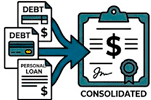
Debt ConsolidationReplace high-interest credit card debt (often 20–29% APR) with a single lower fixed-rate payment. |

Education CostsFund college tuition or vocational training at rates far better than private student loans. |

Medical ExpensesCover large medical bills or procedures without depleting your savings or retirement accounts. |

Investment PropertyUse your primary home's equity as a down payment on a rental or investment property. |

Emergency ReservesEstablish a safety net for unexpected major expenses without touching liquid savings. |
How a Home Equity Loan Works — Step by Step
Getting a home equity loan with Team Aronheim is straightforward. Here's exactly what to expect from first call to closing.
01 |
Assess Your Equity |
02 |
Review Your Profile |
03 |
Home Appraisal |
04 |
Underwriting & Approval |
05 |
Closing & Funding |
06 |
Fixed Repayment |
Home Equity Loan Calculator
Enter your numbers below to instantly estimate your monthly payment, total interest, and loan details. For a personalized rate quote based on your actual credit profile, contact Jeff directly.
Estimate Your Home Equity Loan
* This calculator provides estimates for informational purposes only. Actual loan terms, rates, and available amounts depend on your credit score, property appraisal, lender guidelines, and debt-to-income ratio. Contact Jeff Aronheim for a precise quote.
Home Equity Loan vs. HELOC: Which Is Right for You?
Both products tap your home's equity — but they work very differently. Here's a side-by-side comparison to help you choose.
| Feature | Home Equity Loan | HELOC |
|---|---|---|
| Disbursement | Lump sum at closing | Draw as needed (revolving) |
| Interest Rate | Fixed for life of loan | Usually variable (prime + margin) |
| Monthly Payment | Same every month | Varies with balance and rates |
| Best For | Known, one-time large expense | Ongoing or uncertain expenses |
| Rate Risk | None — rate is locked | Rate rises increase your payment |
| Interest-Only Period | No | Yes (draw period) |
Jeff's take: In a higher-rate environment, I typically recommend a home equity loan for clients who have a specific project or payoff goal and want rate certainty. If you're unsure of your total cost or expect to draw funds over time, a HELOC might serve you better — but we'll review both scenarios together to find what fits your situation.
Home Equity Loan Requirements
Here are the typical qualification benchmarks for a home equity loan. These vary by lender — and we also have Non-QM programs available for borrowers whose income or documentation doesn't fit the conventional standard. We can help you identify the program best matched to your profile.
| Requirement | Minimum Standard |
|---|---|
| Credit Score | 620 |
| Home Equity | 15–20% equity retained post-loan |
| Debt-to-Income Ratio (DTI) | Below 43% |
| Loan-to-Value (CLTV) | Up to 85% |
| Employment / Income | 2 years documented income |
| Property Type | Primary residences, second homes, and investment properties |
Don't meet every criterion above? Talk to Us — there are often solutions for borrowers who don't fit a standard profile.
FAQ
What are current home equity loan rates?
Home equity loan rates are tied to the prime rate and your personal financial profile. As of 2025, rates typically vary based on the prime rate and borrower profile, and may range approximately in the mid-single to low double digits. The best way to know your rate is to get a personalized quote — contact Jeff Aronheim for a no-obligation rate review based on your actual numbers.
How much can I borrow with a home equity loan?
Most lenders allow you to borrow up to 80–85% of your home's value minus your outstanding mortgage balance. For example: home worth $350,000 × 80% = $280,000 maximum combined debt. If you owe $200,000 on your first mortgage, you could potentially borrow up to $80,000. Use our calculator above to estimate your available equity instantly.
Is the interest on a home equity loan tax-deductible?
Interest may be deductible only if the loan is secured by the home and the funds are used to buy, build, or substantially improve the property. If you use proceeds for debt consolidation, education, or other personal expenses, the interest is generally not deductible. Always consult a qualified tax advisor for guidance on your specific situation.
What credit score do I need for a home equity loan?
The minimum is typically 620, but you'll unlock meaningfully better rates at 680+ and the best rates at 740+. If your credit score is below 620, there may still be options — particularly if you have strong equity and a low debt-to-income ratio. Let's discuss your situation before you assume you don't qualify.
How long does it take to get a home equity loan?
The typical timeline from application to funding is 2–4 weeks depending on appraisal and documentation. The home appraisal is usually the longest step. Having your documentation (income verification, mortgage statements, insurance) ready at the start of the process speeds things up significantly.
What's the difference between a home equity loan and cash-out refinance?
A home equity loan is a second mortgage — it sits behind your existing first mortgage and does not change your first mortgage rate. A cash-out refinance replaces your entire first mortgage with a new, larger loan and gives you the difference in cash. If your current mortgage rate is lower than today's rates, a home equity loan protects that existing rate. If you'd benefit from a full refinance, a cash-out refi might make more sense. We'll help you run the numbers on both.
Can I get a home equity loan if I'm self-employed?
Yes. Self-employed borrowers typically need two years of tax returns (personal and business) and a year-to-date profit & loss statement. The process is the same — income is just documented differently. We also have Non-QM programs available for this product — including bank statement and asset-based options — for borrowers whose income doesn't fit a conventional 1040. Jeff has extensive experience with self-employed borrowers and knows exactly what lenders want to see.
I've helped hundreds of homeowners access their equity smartly — whether for renovations, debt payoff, or investment.
Prefer to talk? Call us: +1 720-200-5464