
USDA Loans
Zero Down Rural Home Financing
A USDA home loan is a government-backed mortgage guaranteed by the U.S. Department of Agriculture — designed to help moderate-income buyers in rural and suburban areas purchase a home with no down payment.
- Upfront Fee: 1.0%
- Low mortgage insurance (0.35%/yr)
- Fast pre-qualification — available in 97% of U.S. land area
Get Preapproved Calculate Your USDA Payment
- At Team Aronheim, we help buyers in eligible areas navigate USDA mortgage options with confidence.
- Compare USDA loan requirements, understand income limits, and get pre-qualified — all in one place.
- Backed by CrossCountry Mortgage™ — America's #1 Retail Mortgage Lender for three years running.


last month
What Is a USDA Loan?

A USDA loan (USDA Rural Development mortgage) is a government-backed home loan designed to promote homeownership in rural and suburban areas.
It requires no down payment and often offers below-market interest rates, making it one of the most affordable mortgage options.
Loans are issued by private lenders and guaranteed by the USDA, helping keep rates competitive and qualification requirements flexible.
- 100% financing — no down payment
- Lower MI than FHA
- Competitive fixed rates
- For purchase, and for certain refinance options on existing USDA loans
- Flexible credit (640+ AUS)
- 1% upfront guarantee fee (can be financed)
At Team Aronheim, we help borrowers compare offers from multiple lenders to secure competitive mortgage rates.
USDA Loan Requirements
Down Payment RequirementsUSDA loans offer 100% financing — meaning zero down payment is required. The 1.0% upfront guarantee fee can also be rolled into the loan amount, further reducing out-of-pocket costs at closing. |
Debt-to-Income (DTI) RatioUSDA guidelines typically allow:
|
Employment & Income
|

Property Requirements
|
USDA loan requirements are set by the USDA Rural Development program and enforced by approved lenders. While individual lenders may have slightly stricter overlays, most USDA loan qualifications include the following criteria.
USDA Credit Score Requirements
640+ |
Qualify for automated underwriting (GUS) — fastest approval path |
580–639 |
May qualify through manual underwriting with compensating factors |
0-580 |
Very difficult to qualify — credit improvement recommended |
Tip: Team Aronheim works with borrowers across the credit spectrum, including those who need guidance on improving their score.Get Pre-Qualified Today
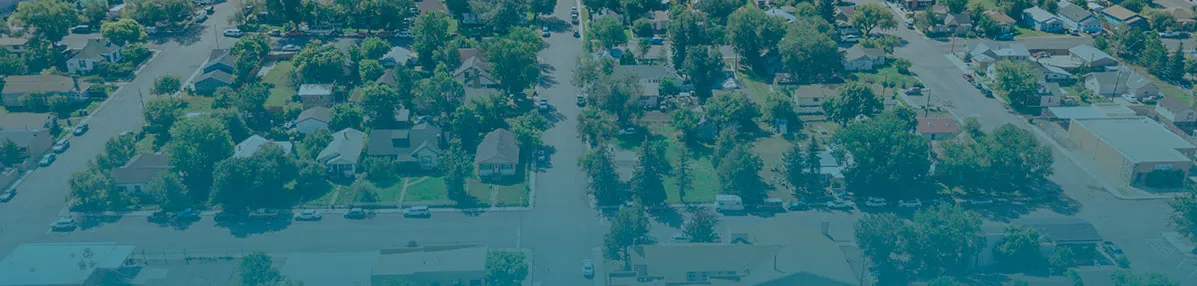
USDA Eligibility Map
Not sure if a property qualifies for a USDA loan? Use the official USDA eligibility map to check any address in seconds. Many suburban areas near major cities are also eligible.
USDA maps are updated periodically based on census and population data, so eligibility can change. Always verify a property before assuming it qualifies.
USDA Coverage by the NumbersSchedule a Meeting
Up to 97% of U.S. land area is USDA-eligible
Roughly 100+ million Americans live in eligible areas
Thousands of communities nationwide are eligible
- Visit the official USDA eligibility website: eligibility.sc.egov.usda.gov
- Select 'Single Family Housing' and enter the exact property address
- The map will indicate whether the location is in an eligible area
- If eligible, contact Team Aronheim to begin your USDA pre-qualification
USDA Guarantee Fee Explained
Instead of private mortgage insurance (PMI), USDA loans charge a government guarantee fee. There are two components — an upfront fee at closing and a small annual fee paid monthly. Both are significantly cheaper than FHA mortgage insurance premiums.
Two Types of USDA Guarantee Fees| Fee Type | Amount | When Paid |
|---|---|---|
| Upfront Guarantee Fee | 1.0% of loan amount | At closing — can be financed into the loan |
| Annual Guarantee Fee | 0.35% per year | Monthly, for the life of the loan |
USDA annual guarantee fee is 0.35%. FHA annual MIP varies by loan characteristics and is often higher.
Real Dollar Example — $250,000 Loan
USDA annual fee: $875/year = $73/month FHA annual MIP: $2,125/year = $177/month USDA saves approximately $104/month vs. FHA — that's $1,248/year, or $37,440 over a 30-year loan
USDA Loan Zero Down Payment
The USDA loan's most powerful feature is 100% financing — meaning qualified buyers can purchase a home with absolutely no down payment. This makes USDA one of only two government programs (alongside VA loans) offering true zero-down home financing. Compare this to FHA loans (3.5% minimum) and conventional loans (3%+). On a $280,000 home, a USDA loan saves you $9,800 to $56,000 in upfront cash compared to other programs.
Down Payment Comparison by Loan Type| Home Price | USDA (0%) | VA (0%) | FHA (3.5%) | Conv. (5%) |
|---|---|---|---|---|
| $200,000 | $0 | $0 | $7,000 | $10,000 |
| $280,000 | $0 | $0 | $9,800 | $14,000 |
| $350,000 | $0 | $0 | $12,250 | $17,500 |
| $400,000 | $0 | $0 | $14,000 | $20,000 |
USDA Loan Income Limits
USDA loan income limits are set at 115% of the median household income for each county and are updated annually by the USDA. The limit applies to total household income — not just the borrower's — meaning all adults living in the home are counted, whether or not they are on the loan.
The good news: USDA income limits are often higher than people expect. The program also allows deductions for dependents, childcare expenses, disability, and certain medical costs — which can reduce your counted household income and help you stay under the limit.
Allowed Income Deductions The USDA allows certain deductions that reduce your counted household income: • $480 per dependent child under 18 • $480 per full-time student (18+) living in the home • Documented childcare expenses for children under 12 • Annual medical expenses exceeding 3% of gross income (for elderly/disabled households) • $400 deduction for elderly households (62+)* Sample national baseline figures. Limits vary by county. High-cost areas have higher limits. Contact Team Aronheim for the exact limit in your area.
Current USDA Loan Rates
USDA rates are often competitive and may be lower than comparable conventional options, depending on market conditions and borrower profile.
What Affects Your USDA Loan Rate?
- Credit score — higher scores qualify for better rates
- Loan term — 30-year is most common; 15-year usually has lower rates
- Market conditions — Fed policy, bond yields, inflation
- Lender pricing and margins
- Debt-to-income ratio and overall risk profile
USDA loans also include a 0.35% annual guarantee fee, while conventional loans may require PMI, which can be removed after 20% equity.
The best way to know your actual USDA mortgage rate is to request a personalized quote. Team Aronheim compares offers across multiple lenders to find the most competitive current USDA rates for your profile. Even a 0.25% rate difference on a $280,000 loan saves over $13,500 in interest over 30 years.Get Pre-Qualified Today
USDA Loan Calculator
Before applying for a USDA loan, it helps to estimate your monthly payment. In addition to principal, interest, taxes, and insurance, USDA payments include a 0.35% annual guarantee fee and a 1.0% upfront fee, typically financed into the loan.
USDA vs. FHA vs. VA vs. Conventional Loans
Choosing the right mortgage depends on your eligibility, credit profile, income, and location. Here's how USDA home loans compare to other popular programs across the criteria that matter most.
| Feature | USDA Loan | FHA Loan | VA Loan | Conventional |
|---|---|---|---|---|
| Down Payment | 0% | 3.5% | 0% (veterans) | From 3% |
| Min. Credit Score | 640 (auto) | 580 | No official min. | 620 |
| Mortgage Insurance | 0.35%/yr annual fee | 0.85%/yr (often for life) | None | PMI (removable) |
| Upfront Fee | 1.0% (financeable) | 1.75% UFMIP | 1.25–3.3% funding fee | None |
| Location Requirement | Rural/suburban area | None | None | None |
| Income Limit | 115% area median | None | None | None |
| Loan Limits (2026) | No hard cap* | $541,287 to $1,249,125, depending on county | No limits (veterans) | Up to $832,750+ |
| Best For | Rural/suburban buyers, 0% down | Lower credit / savings | Veterans & service members | Good credit buyers |
Who Is a USDA Loan Best For?
USDA home loans are one of the most underutilized mortgage programs in the U.S. — largely because many buyers don't realize they're eligible. Here are three common borrower profiles that benefit most from USDA financing.
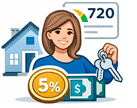
First-Time Buyer, No Savings
Scenario A
Jessica has a steady job and a 660 credit score but hasn't saved for a down payment. A USDA loan lets her buy a home in a qualifying suburb with $0 down — her only upfront costs are closing fees, which can often be negotiated with the seller.

Suburban Move-Up Buyer
Scenario B
David and Maria want more space and find a home in a town of 20,000 — within USDA eligibility. With a 700 score and moderate income, they secure a USDA mortgage at a rate below the conventional market, with no down payment required.
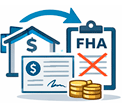
FHA → Conventional Refinance
PMI Removal
A homeowner with an FHA loan refinances into a conventional loan after reaching 20% equity. This removes FHA MIP entirely, potentially saving $150–$300/month, depending on loan size and credit profile.
USDA Loan FAQ
What is a USDA loan?
A USDA loan is a mortgage backed by the U.S. Department of Agriculture. It is designed for moderate-income buyers in rural and qualifying suburban areas, offering 100% financing (no down payment), competitive rates, and lower mortgage insurance than FHA loans.
What are the USDA loan requirements?
Key requirements include: property must be in a USDA-eligible area, household income must not exceed 115% of the area median income, a credit score of 640+ is recommended for automated underwriting, stable 2-year employment history, and the home must be a primary residence.
How do I check the USDA eligibility map?
Visit eligibility.sc.egov.usda.gov and enter the property address. The map will indicate whether the location qualifies. Many suburban areas near large cities are USDA-eligible — it's worth checking even if you don't consider your target area "rural."
What are the USDA income limits?
USDA income limits are set at 115% of the area median income and vary by county and household size. For a typical 1–4 person household, limits often range from $90,000 to $120,000+. Certain deductions (dependents, childcare, medical) can reduce your counted income. Contact Team Aronheim for the exact limit in your county.
Is USDA really a zero down payment loan?
Yes. USDA loans offer 100% financing, meaning no down payment is required. The 1% upfront guarantee fee can also be rolled into the loan amount, so many buyers close with minimal or no cash out of pocket — primarily covering closing costs.
What is the USDA guarantee fee?
The USDA charges two fees instead of traditional PMI: a 1.0% upfront guarantee fee (paid at closing or financed into the loan) and a 0.35% annual fee (paid monthly). This is considerably cheaper than FHA's 1.75% upfront MIP + 0.85% annual MIP.
What credit score do I need for a USDA loan?
Most lenders require 640+ for automated underwriting. Borrowers with scores of 580–639 may qualify through manual underwriting with compensating factors. Team Aronheim works with borrowers across the credit spectrum.
What are current USDA mortgage rates?
USDA mortgage rates change daily based on market conditions and your credit profile. They are typically 0.25%–0.50% lower than comparable conventional loan rates due to the government guarantee. Contact Team Aronheim for a personalized rate quote.
Can I use a USDA loan if I'm not a first-time buyer?
Yes. USDA loans are available to any qualified borrower — first-time or repeat buyer — as long as the property is in an eligible area, will be the primary residence, and the household meets income limits. You cannot own another adequate housing at the time of closing.
Can I refinance my USDA loan?
Yes. USDA offers a Streamline Refinance — a simplified refi program for existing USDA borrowers with no appraisal required in most cases and minimal documentation. A Non-Streamlined option is also available for those who need to roll in closing costs or want a full new appraisal.
Get a personalized USDA mortgage quote from Team Aronheim at CrossCountry Mortgage. No obligation — just clear guidance on whether you qualify and what your payment would look like.
Prefer to talk? Call us: +1 720-200-5464