
FHA Loans
Requirements, Rates, and Down Payment Options
An FHA loan is a government-backed mortgage insured by the Federal Housing Administration — designed to make homeownership accessible for buyers with lower credit scores or limited savings. Learn what an FHA home loan is, how FHA loan requirements work, what down payment you need, and whether this mortgage is the right choice for you.
- Best for First-time Homebuyers
- Minimum Down Payment: 3.5%
- Min. Credit Score: 580
- MIP: Not Removable
- Loan Limits: Vary by County
Get Preapproved Calculate Your FHA Payment
- At Team Aronheim, we help first-time buyers and repeat buyers navigate FHA mortgage options with confidence.
- Compare FHA loan rates, understand FHA qualifications, and get pre-qualified — all in one place.
- Backed by CrossCountry Mortgage™ — America's #1 Retail Mortgage Lender for three years running.


last month
What Is an FHA Loan?

An FHA loan is a mortgage insured by the Federal Housing Administration (FHA), part of the U.S. Department of Housing and Urban Development (HUD). Because the government backs these loans, private lenders can offer them to borrowers who may not qualify for a conventional mortgage.
Created in 1934 to stabilize the housing market, FHA loans have helped millions of Americans buy homes. Today, they remain a popular option for first-time buyers, borrowers with lower credit scores, and those with limited down payment savings.
- 3.5% down
- 580+ credit score (500 with 10% down)
- Flexible DTI
- Competitive rates
- Up to 6% seller contribution
- For purchase, refinance, or 203(k) renovation
At Team Aronheim, we help borrowers compare offers from multiple lenders to secure competitive mortgage rates.
FHA Loan Requirements
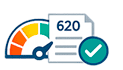
Down Payment RequirementsThe FHA down payment minimum is 3.5% for borrowers with a credit score of 580 or higher. Down payment funds can come from savings, a gift from a family member, or down payment assistance programs. |

Debt-to-Income (DTI) RatioFHA guidelines typically allow:
|

Employment & Income
|

Property Requirements
|
FHA loan requirements are set by HUD and enforced by approved lenders. While individual lenders may have slightly stricter "overlay" standards, the core FHA qualifications are designed to be accessible for a wide range of borrowers.
FHA Credit Score Requirements
580+ |
Qualify for 3.5% minimum down payment |
500–579 |
May qualify with 10% down payment |
0-500 |
Not eligible for FHA financing |
Tip: Many lenders set their minimum at 620. Team Aronheim works with borrowers across the credit spectrum.Schedule a Meeting
FHA Mortgage Insurance Premium (MIP)
One of the most important aspects of an FHA loan is the mandatory mortgage insurance premium, or FHA MIP. Unlike conventional PMI, FHA mortgage insurance is required regardless of your down payment amount — and in most cases, it stays for the life of the loan.
Two Types of FHA MIP| Type | Amount | When Paid |
|---|---|---|
| Upfront MIP (UFMIP) | 1.75% of the loan amount | At closing (can be rolled into loan) |
| Annual MIP | 0.55%–1.05%/year (varies by loan) | Monthly, for life of loan (usually) |
Can FHA Mortgage Insurance Be Removed?
The one-time Upfront MIP (UFMIP) is rolled into the loan at closing and cannot be removed. The monthly MI may cancel after 11 years — but only if your down payment was 10% or more (for loans originated on or after June 3, 2013). With less than 10% down, monthly MI stays for the life of the loan. To eliminate it entirely, the borrower must refinance into a conventional loan.
MIP vs. PMI — What's the Difference?
Conventional PMI can be removed automatically once you reach 20% equity. With FHA, the monthly mortgage insurance (in most cases) cannot be removed unless you refinance — making it a key reason many borrowers eventually move to a conventional loan.
FHA Loan Down Payment Options
FHA loans offer more than just a low down payment — they come with flexible underwriting guidelines that make it easier to qualify, and loan terms that are far less sensitive to your credit score compared to conventional financing. That combination makes FHA one of the strongest options available for first-time homebuyers.
Down Payment: FHA vs Conventional| Home Price | FHA (3.5%) | Conv. (5%) | Conv. (20%) |
|---|---|---|---|
| $200,000 | $7,000 | $10,000 | $40,000 |
| $280,000 | $10,500 | $15,000 | $60,000 |
| $350,000 | $14,000 | $20,000 | $80,000 |
| $400,000 | $17,500 | $25,000 | $100,000 |
The minimum down payment of 3.5% is a major part of that advantage. On a $300,000 home, that's just $10,500 out of pocket — compared to $15,000 for a 5% conventional loan or $60,000 for the traditional 20% down.FHA does not require gift funds to be seasoned for a specific period — making it highly accessible for first-time buyers receiving family help
FHA Loan Limits for 2026
Each year, the Federal Housing Administration sets maximum FHA loan limits by county based on median home prices in each area. These FHA lending limits determine the maximum amount you can borrow with an FHA mortgage in your location.
FHA loan limits by county vary significantly. In high-cost metro areas like San Francisco, New York, and Los Angeles, FHA maximum loan limits are substantially higher than the national floor.
Loans above FHA limits require either a Jumbo loan or a conventional mortgage. Team Aronheim can help you understand the limits in your specific county and explore all available options.
Current FHA Mortgage Rates
FHA mortgage rates today are set daily by individual lenders based on market conditions, the bond market, and each borrower's financial profile. Because FHA loans are government-insured, they typically carry slightly lower interest rates than conventional mortgages for borrowers with similar credit profiles.
What Affects Your FHA Loan Rate?
- Credit score — higher scores unlock better rates even within FHA
- Down payment amount — 3.5% vs. 10% can influence rate offers
- Loan term — 15-year FHA rates are lower than 30-year
- Loan-to-value ratio (LTV)
- Current market conditions — Fed policy, bond yields, inflation
- Lender pricing and margin
FHA rates are typically 0.25%–0.50% lower than comparable conventional loan rates, but the total cost of an FHA loan may be higher due to mandatory mortgage insurance premiums (MIP). A personalized comparison is essential.
The best way to know your actual FHA mortgage rate is to request a personalized quote. Team Aronheim compares offers across multiple lenders to find the most competitive current FHA rates for your profile. Even a 0.25% rate difference on a $350,000 loan saves over $17,000 in interest over 30 years.Get Pre-Qualified Today
FHA Loan Calculator
Before applying for an FHA mortgage, it's helpful to estimate your monthly payment. Unlike conventional loans, an FHA payment includes both principal and interest AND mandatory mortgage insurance premiums (MIP).
FHA vs. Conventional Loans: Which Is Right for You?
Choosing between an FHA loan and a conventional mortgage is one of the most important decisions homebuyers face. The right answer depends on your credit score, down payment, and long-term goals.
| Feature | FHA Loan | Conventional | VA |
|---|---|---|---|
| Min. Credit Score | 580 (3.5% down) / 500 (10% down) | 620 | No official min. |
| Down Payment | 3.5% | As low as 3% | 0% |
| Mortgage Insurance | MIP (often lifetime) | PMI (removable) | None |
| Upfront Fee | 1.75% UFMIP | None | Funding fee 1.25–3.3% |
| Property Types | Primary only | Primary, vacation, investment | Primary only |
| Loan Limits (2026) | Up to $524,225+ | Up to $832,750+ | No limits |
| Best For | Lower credit / savings | Good credit buyers | Veterans & service members |
FHA Loans for First-Time Homebuyers
FHA loans are widely regarded as the best mortgage option for first-time homebuyers — and for good reason. The program was specifically designed to lower the barriers to homeownership for buyers who are just getting started.
Limited Savings
Scenario A
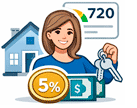
Jamie just started a new job and has $15,000 saved. With FHA's 3.5% down payment on a $350,000 home ($12,250 down), Jamie can preserve emergency savings and still achieve homeownership.

Credit Rebuilding
Scenario B
Alex has a 610 credit score after some past financial hardship. A conventional loan is out of reach, but FHA's flexible credit requirements make homeownership possible today.
FHA Is NOT Just for First-Time Buyers
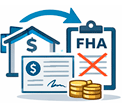
Despite its reputation, FHA loans are available to ANY qualified borrower — not just first-time buyers. Repeat buyers, homeowners refinancing, and investors in 2-4 unit properties (owner-occupied) can all use FHA financing.
FHA Loan FAQ
What is an FHA loan?
An FHA loan is a mortgage insured by the Federal Housing Administration. It is designed for buyers with lower credit scores or limited down payment savings and is one of the most popular loan types for first-time homebuyers in the U.S.
What credit score do I need for an FHA loan?
The minimum FHA credit score is 580 for a 3.5% down payment. Borrowers with scores between 500–579 may still qualify with a 10% down payment. Scores below 500 are not eligible.
How much down payment is required for an FHA loan?
FHA requires a minimum down payment of 3.5% for borrowers with credit scores of 580 or higher. With scores of 500–579, the required down payment increases to 10%.
What are current FHA mortgage rates?
FHA mortgage rates change daily. They are influenced by market conditions, your credit score, loan term, and lender pricing. Contact Team Aronheim for a personalized FHA rate quote based on your specific profile.
Do FHA loans require mortgage insurance?
Yes. FHA loans require both an upfront MIP (1.75% of the loan) and an annual MIP (0.55%–1.05%). For loans with less than 10% down, annual MIP typically lasts the full loan term. Borrowers can remove it by refinancing into a conventional loan once they reach sufficient equity.
What are the FHA loan limits for 2026?
For 2026, the FHA loan limit for standard areas is approximately $524,225 for a single-family home. High-cost markets allow up to $1,209,750. Limits vary by county — contact us to find the limit for your area.
What is an FHA 203k loan?
The FHA 203k loan is a renovation mortgage that allows buyers to finance both the home purchase and renovation costs in a single loan. There are two types: Standard 203k (major rehab) and Limited 203k (up to $35,000 in minor improvements).
Can I refinance my FHA loan?
Yes. FHA offers the Streamline Refinance — a simplified refi program for existing FHA borrowers with no appraisal required in most cases. You can also refinance into a conventional loan once you have enough equity to eliminate FHA mortgage insurance.
Is FHA better than conventional?
For borrowers with credit scores below 680 or limited savings, FHA often offers better rates and more accessible approval. For borrowers with strong credit and 20%+ down, conventional loans typically offer lower long-term costs due to removable PMI and no upfront insurance fee.
Can I use an FHA loan if I'm not a first-time buyer?
Yes. FHA loans are available to any qualified borrower — first-time or repeat buyer — as long as the property will be their primary residence.
Get a personalized FHA mortgage quote from Team Aronheim at CrossCountry Mortgage. No obligation — just clear guidance on your FHA loan requirements, current FHA rates, and whether an FHA home loan is the right choice for you.
Prefer to talk? Call us: +1 720-200-5464