
Conventional Loans
Requirements, Rates, and Down Payment Options
A conventional mortgage is one of the most popular ways to buy a home in the U.S. Learn how it works, what credit score you need, how much down payment is required, and whether this loan type is right for you.
Get Preapproved
Calculate Your Monthly Payment
- No obligation consultation
- Personalized loan comparison
- Fast pre-approval


last month
What is a Conventional Loan?

A conventional home loan is a mortgage that is not backed by a government program. Instead, it follows guidelines established by Fannie Mae and Freddie Mac.
Because these loans meet the standards of these agencies, lenders can sell them on the secondary mortgage market, which helps keep conventional mortgage rates competitive.
- Competitive interest rates
- Down payments as low as 3%
- No upfront mortgage insurance fee
- Ability to remove PMI later
At Team Aronheim, we help borrowers compare offers from multiple lenders to secure competitive conventional mortgage rates.
Conventional Loan Requirements
While requirements vary slightly between lenders, most conventional loan qualifications include:
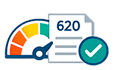
Credit Score 620+Most lenders require at least 620. Better rates are available for borrowers with 700+ |

Down PaymentOptions range from 3% for qualifying programs up to 20% to avoid PMI entirely. |

Debt-to-IncomeDTI ratio typically must be below < 50%, including the new mortgage payment. |

Stable IncomeProof of employment and a consistent 2-year income history are generally required. |
Down Payment Options
One of the biggest myths is that you must put 20% down to qualify for a conventional loan. In reality, several programs allow much smaller down payments.
The Conventional 97 program allows qualified buyers to purchase a home with just 3% down — making homeownership accessible for many first-time buyers.
3% |
Most Popular
Conventional 97 Program |
5% |
Standard Conventional |
10% |
Reduced PMI |
20% |
No PMI Required |
Conventional Loan Limits for 2026
Conventional mortgages must stay within the conforming loan limits set annually by the Federal Housing Finance Agency.
For most areas in 2026, the standard limit is:
High-cost markets may allow significantly higher limits.
Loans above these thresholds are considered jumbo loans and follow different underwriting rules.
Get Pre-Qualified Today Fannie Loan Limits
Private Mortgage Insurance (PMI)
If you put less than 20% down, lenders typically require Private Mortgage Insurance. PMI protects the lender in case of default — but the good news is, it's not permanent.
- Reach 20% equity in the home
- Request PMI cancellation from your lender
- Refinance the mortgage
PMI typically costs between 0.5% – 1.5% of the loan amount annually. On a $400,000 loan, that's roughly $167–$500/month — which disappears once you hit 20% equity.
Conventional Loan Calculator
Before applying, estimate your potential monthly mortgage payment. Adjust the inputs to explore different scenarios.
Our calculator allows you to estimate:
- Estimated monthly payment
- Principal & interest breakdown
- PMI estimate
- Total loan cost over time
Get Pre-Qualified Today
Conventional vs FHA vs VA Loans
Choosing the right mortgage depends on your credit profile, down payment, and financial goals.
| Feature | Conventional Recommended | FHA | VA |
|---|---|---|---|
| Minimum Credit Score | 620+ | 580 (500 w/ 10% down) | No official minimum |
| Down Payment | As low as 3% | 3.5% | 0% (for eligible veterans) |
| Mortgage Insurance | PMI (removable) | MIP (often for life) | None |
| Upfront Insurance Fee | None | 1.75% upfront MIP | Funding fee (1.25–3.3%) |
| Loan Limits (2026) | Up to $832,750+ | Area-based limits | No loan limits for eligible veterans |
| Property Types | Primary, vacation, investment | Primary only | Primary only |
| Best For | Good credit buyers | Lower credit borrowers | Eligible veterans & service members |
Who is a Conventional Loan Best For?

First-Time Homebuyer
Example Profile
Sarah has a credit score of 720 and saved 5% for a down payment. A conventional mortgage allows her to buy a home with competitive rates and the ability to remove PMI later as she builds equity.

Buyer with strong credit
Example Profile
Michael has a credit score of 760 and 20% down. A conventional loan gives him the lowest possible mortgage rate with no PMI — maximizing his long-term savings.
Homeowner refinancing
Example Profile
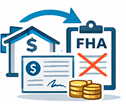
A homeowner who built equity in an FHA loan may refinance into a conventional loan to eliminate mandatory mortgage insurance — potentially saving hundreds per month.
Conventional Loan FAQ
What is a conventional loan?
A conventional loan is a mortgage that is not insured or guaranteed by a government agency. Instead, it follows lending standards set by Fannie Mae and Freddie Mac.
What credit score is required for a conventional loan?
Most lenders require at least 620, though better rates are typically available for scores above 700.
How much down payment is required?
Depending on the program, borrowers may qualify with 3%, 5%, or 20% down.
Do conventional loans require PMI?
Yes, if your down payment is below 20%. However, PMI can usually be removed once you reach enough equity.
What are conventional mortgage rates today?
Mortgage rates change daily based on market conditions, borrower credit profile, and loan structure.
Is conventional better than FHA?
For borrowers with good credit and stable income, conventional loans often provide lower long-term costs.
Get a personalized conventional loan quote from Team Aronheim at CrossCountry Mortgage. No obligation — just clear guidance on your best options.
Prefer to talk? Call us: +1 720-200-5464